
Temple of Heaven
Category: World Heritage Sites
Address : No.16 Tiantan East Rd., Chongwen District
Open Time : Daily 5:30am - 5:00pm
Reviews: 
Phone : 86-10-67028866
Entrance fee: RMB35/p.p
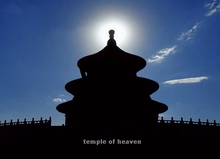
Introduction of Temple of Heaven Beijing
The Temple of Heaven is situated in the southern part of Beijing. It was first built in 1420 in the Ming Dynasty during the time when the Forbidden City ans some other important imperial structures were constructed. It covers an area of 273 hectares, which is 3 times larger than the Forbidden City. The Temple of Heaven is not only the largest group of temple building in China, but also the largest heaven-worshipping architecture in the world.
Function
Temple of Heaven was the place where the emperors of the Ming and Qing dynasties worshipped heaven and prayed for good harvests. The emperors visited the temple three times a year: on the 8th day of the first lunar month to pray for a good harvest; during the Summer Solstice to pray for rain; and during Winter Solstice to give thanks for a good harvest. During each ceremony, the emperors worshipped heaven and prayed for a good harvest. In addition, the emperors also worshipped their ancestors and other natural phenomena such as the Cloud God, Rain God and Wind God. In imperial days, the Chinese people believed that the sky was incircular shope and the earth was square. On the basis of this tranditional concept, the circle was widely adopted in the design of the temple's main building. It is in accord with people's imagination of heaven.
Features & Symbolize
The Temple is divided by two enclosed walls into inner part and outer part. The main buildings of the Temple lie at the south and north ends of the middle axis line of the inner part. The most magnificent buildings are The Circular Mound Altar (Yuanqiutan), Imperial Vault of Heaven (Huangqiongyu) and Hall of Prayer for Good Harvest (Qiniandian) from south to north. Also, there are some additional buildings like Three Echo Stones and Echo Wall. Almost all of the buildings are connected by a wide bridge called Vermilion Steps Bridge (Danbiqiao) or called Sacred Way.
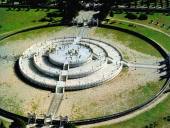
Almost all of the buildings are connected by a wide bridge called Vermilion Steps Bridge (Danbiqiao) or called Sacred Way. The Circular Mound Altar has three layered terraces with white marble. During the Ming and Qing Dynasties (1368 A.D. - 1911 A.D.), the emperors would offer sacrifice to Heaven on the day of the Winter Solstice every year. This ceremony was to thank Heaven and hope everything would be good in the future.
The Hall of Prayer for Good Harvest
A big palace with round roof and three layers of eaves. Inside the Hall are 28 huge posts. The four posts along the inner circle represent four seasons-spring, summer, autumn and winter; the 12 posts along the middle circle represent the 12 months; and 12 posts along the outer circle represent 12 Shichen (Shichen is a means of counting time in ancient China. One Shichen in the past equaled two hours and a whole day was divided into 12 Shichens). The roof is covered with black, yellow and green colored glaze representing the heavens, the earth and everything on earth. The Hall has a base named Altar for Grain Prayers which is made of three layers of white marble and has a height of six meters.
Another important building in Temple of Heaven is Imperial Vault of Heaven. If you look at it from far away, you will find that the Vault is like a blue umbrella with gold head. The structure of it is like that of Hall of Prayer for Good Harvest, but smaller in size. The structure was made of bricks and timber. The Vault was used to place memorial tablets of Gods. White marble railings surround the vault.
The Vermilion Steps Bridge connects the Hall of Prayer for Good Harvest and the Imperial Vault of Heaven. The south end of the Bridge is lower than its north end. The emperors in the past believed that they could go to heaven through this Bridge, which is why this bridge is also called Sacred Way. A Yu Route and a Wang Route are on 2 sides of Sacred Way. The former one is only for the emperors to walk on and the later one is for the princes and the high officials to pass.
Three Echo Stones is outside of the gate of the Imperial Vault of Heaven. If you speak facing the Vault while standing on the first stone, you will hear one echo; standing on the second and then the third stone, you will hear two and three echoes respectively.
Another interesting and famous place for you to visit is called Echo Wall owning special feature. The wall encloses the Imperial Vault of Heaven. Its perimeter is 193 meters. If you and your friend stand at the east and the west roots of the wall respectively and you whisper a word, then your friend will hear clearly what you say. Isn't it interesting?The phenomenon utilizes the theory of sound wave.Besides carefully designed buildings, there are also some other scenes that you can enjoy like Nine-Dragon Cypress. It got its name from branches which look like nine dragons wind with each other. It was said that the cypress was planted more than 500 years ago. Really, a grandfather tree!
Beijing-Travels.com offers online information on Beijing Temple of Heaven and private tours as follows, Keep browsing our site for More Attractions information in Beijing China.
Private Tours of Temple of Heaven
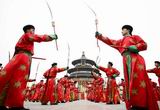

If you could not meet a interesting tours which our predesigned with Temple of Heaven, we will customize a tour to fit your exact needs.
Special Offer Travels
Beijing-Travels.com is a full service local travel agency offers popular travel packages to Beijing, Great Wall and all over of China. We specialize in "PRIVATE" & "NO-SHOPPING" tours and try to be original, unique and best to satisfy our clients, Let us assist you to experience your own vacations!

 home
home about us
 Testimonials
 sales@beijing-travels.com
 0086-13801067568
