
The Giant Panda
Attractions: Beijing Zoo
Address : 137 Xizhimen waidajie, Xicheng District
Open Time : Daily 8:30am - 5:30pm
Reviews: 
Phone : 86-10-68314411
Entrance fee: RMB 25/p.p
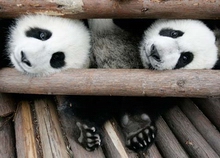
Introduction of The Giant Panda
The Giant Panda is one of the rarest animals in the world. It is a species or kind, of bear and is found only in China. They are solitary animals, living alone in the forests.
Appearance
They are black and white animals with round heads, small black ears and white faces. They have black patches around each eye. They have short tails. They walk on all fours and can climb trees, often doing so to find a place to sleep. An adult Giant Panda is about 150 centimetres long and weighs about 90 kilograms, although the biggest one ever weighed was 180 kilograms.
Habitat
Giant Pandas live in bamboo forests in the mountains of western China. The forests are very thick and the pandas are generally hidden from view, so it has been hard for scientists to learn about them. This lack of knowledge has added to the difficulty of saving these animals. Once pandas were widespread throughout China, but the bamboo forests in eastern China have been cut down for farming. This has made the forest areas into 'islands', making it impossible for the bears to roam widely and meet each other to mate.
Feeding
About 99% of the Giant Panda's food is bamboo, though it also eats grass, roots, plants and even meat. Bamboo is actually a type of grass that grows as tall as trees. Although there are hundreds of kinds of bamboo, the Giant Panda eats only 4 or 5 kinds. It is estimated that a Giant Panda can chew more than 3,500 stalks of bamboo a day. Bamboo is not very nutritious, so the Giant Panda spends about 12 hours a day feeding.
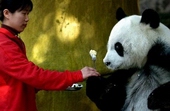
The front paws of the Giant Panda are specially adapted to help it hold bamboo. There is a bone on each palm which looks a little like a thumb. The panda's five fingers are wrapped around the bamboo stalk, and the 'thumb' moves forward to jam against the bamboo so that it is firmly held. The Giant Panda also has very large teeth, strong jaws and huge cheek muscles to help it crush the hard bamboo.
Life Cycle
Baby pandas are very small when they are born. They only weigh about 120 grams. The mother holds the new baby in a similar way to a human, cradling the baby in her arms. The baby panda's eyes open after about 40 days. At one month old the black markings can be seen on their pink skin. At three months old the young pandas are furry, black and white miniatures of their parents. They crawl when they are about 3-4 months old. At 7 months, a young panda weighs about 9 kilograms, runs and climbs trees, and has started eating bamboo. At about 18 months, it weighs about 55 kilograms, and will soon leave its mother.
Status
Giant Pandas are endangered because the bamboo forests are being cleared for farming. Different types of bamboo die off every 40 to 100 years and because of the clearing, there are fewer types of bamboo left. Pandas often starve when bamboo dies off. In the past they were hunted for fur or trained as performing circus animals. Giant Pandas are now protected by law.
In China, research and breeding centres have been set up and are trying to breed them to increase their numbers. This is a very slow and difficult process, and so far the success is limited.
Beijing-Travels.com offers online information on The Giant Panda and private tours as follow, Keep browsing our site for More Attractions information in Beijing China.
Private Tours of Giant Panda Zoo

If you could not meet a interesting tours which our predesigned with Giant Panda Zoo, we will customize a tour to fit your exact needs.
Special Offer Travels
Beijing-Travels.com is a full service local travel agency offers popular travel packages to Beijing, Great Wall and all over of China. We specialize in "PRIVATE" & "NO-SHOPPING" tours and try to be original, unique and best to satisfy our clients, Let us assist you to experience your own vacations!


 home
home about us
 Testimonials
 sales@beijing-travels.com
 0086-13801067568
